Introduction
Welcome to the official IsoFind documentation. IsoFind is an all-in-one platform designed to transform your isotopic analyses into actionable results, while securing your data against accidental or fraudulent modification.
Whether you are in the field or in the laboratory, IsoFind adapts to your expertise. The software simplifies the processing of complex data by automating tedious calculations, allowing you to focus on what matters most: interpretation and decision-making.
Guided Path
Let yourself be guided step-by-step. Ideal for quickly processing prospecting or control data without requiring advanced IT expertise.
Total Control
Fine-tune every scientific parameter, customize your geochemical models, and manage your laboratory certificates independently.
Quick Links
The documentation covers a wide scope. Here are the most useful entry points depending on your immediate objectives.
Start Installation
Download IsoFind, first launch, and initial workstation configuration.
Import Your First Data
CSV, Excel, automatic column mapping, and step-by-step workflow.
Understand the 8 Data Families
Analytics, methods, purification, geochemistry, molecules, isotopes, vertical profiles, notes.
Explore Geochemistry Module
156 catalogued molecules, 11 inorganic elements, 50 degradation pathways, 56 CSIA fractionations.
Using CSIA
Compound-specific fractionation, dual isotope C/Cl and C/N, mechanistic diagnostics.
Launch a 3D Simulation
ADE engine, ML priors, Nexus bridge, redox speciation, multi-hypothesis comparison.
Generate a Report
Templates, custom blocks, FAIH philosophy, ECDSA P-256 signature.
Quick Origin Detection
Quick Match on isotopic signatures, automated source attribution.
Choose an IsoFind Edition
Pro, Lite, GeoFind, PetroFind, SupplyFind: five editions, same codebase.
Cryptographic Security
ISOF format, ECDSA P-256 signature, three-level PKI trust chain.
Integrate via API
REST endpoints to automate imports, analyses, exports, and reports.
Backup the Database
Local, encrypted, or cloud backup (WebDAV, network path, S3).
Versatility and Application Fields
IsoFind was developed to meet the rigorous precision and traceability requirements shared across several strategic sectors. Its strength lies in its ability to process isotopic data regardless of its origin:
- Environment and Hydrosystems: Pollution source tracking, groundwater remediation monitoring, and establishing environmental liability.
- Forensics and Security: Authentication of strategic materials, anti-counterfeiting measures, and determining the geographical origin of seized goods.
- Energy and Mining Prospection: Organic maturity assessment, hydrothermal distality modeling, and critical metals exploration (Lithium, Rare Earth Elements).
- Industry and Certification: End-to-end raw material traceability and issuance of secure origin certificates for sovereign value chains.
Application Domains
Forensics & Security
Product authentication and forensic traceability.
E&M Prospection
Modeling of mining, oil, and gas deposits.
Environment
Plume monitoring and pollution source tracking.
IsoFind operates entirely locally. No data is transmitted to the cloud, ensuring compliance with the strictest security requirements, including air-gapped environments.
Dashboard and Visualisation
The dashboard centralises the intelligence of your data. More than a simple sample list, it integrates IsoFind's analysis engine which continuously evaluates the quality of your measurements: outlier identification, statistical robustness verification, per-sample reliability score. Data is therefore always ready for analytical, forensic, or industrial use.
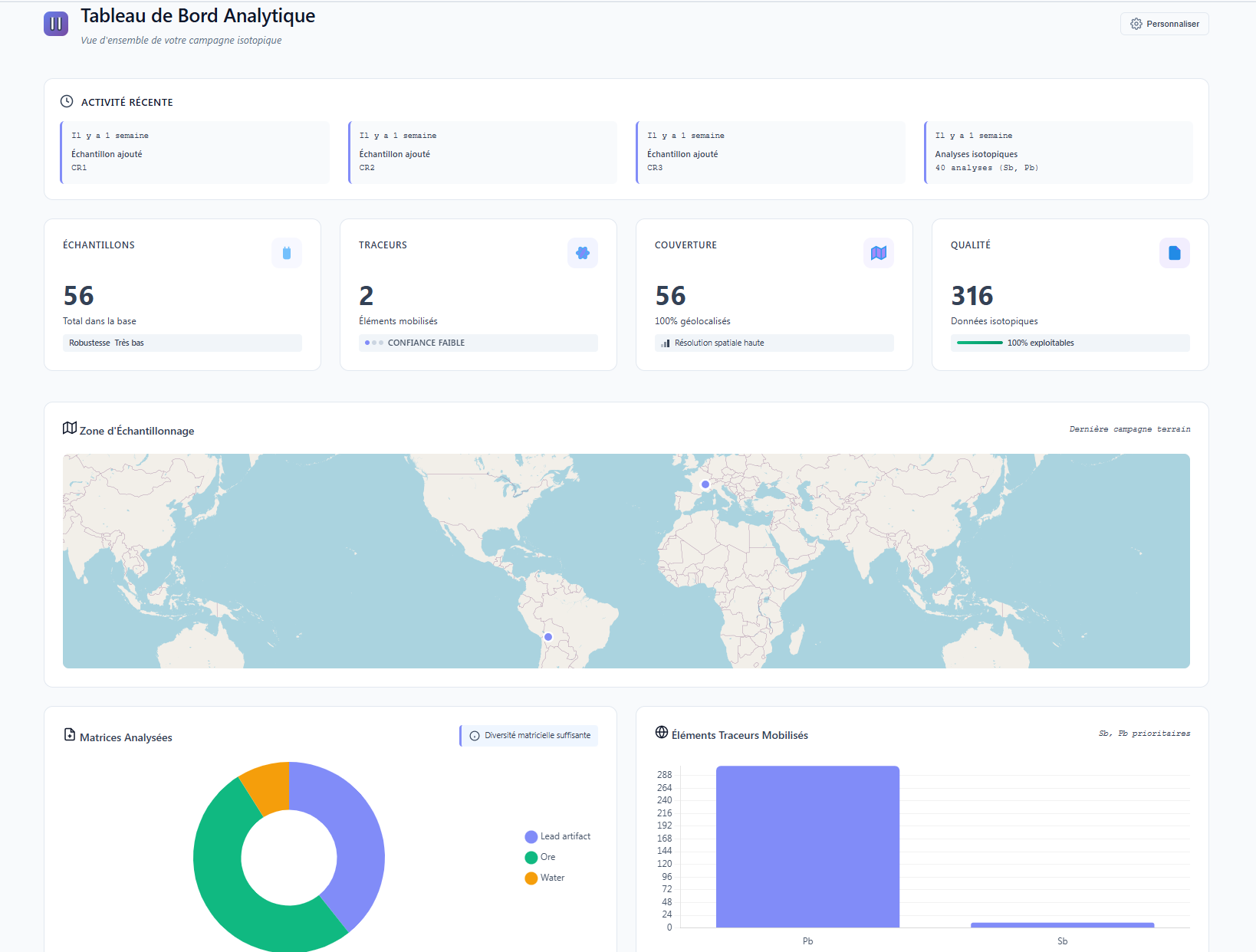 Figure 1: Main dashboard and mapping module.
The ISOF Standard
The ISOF format (Isotopic Open Format) does not merely store isotopic ratios. It encapsulates the complete analytical lineage: digestion protocols, purification yields, and reference standards. The ECDSA P-256 signature makes this capsule tamper-proof, guaranteeing full traceability and admissibility during inter-laboratory exchanges.
Structure of a .isof file
Raw Data
Isotopic ratios, uncertainties
Analytical Metadata
Methods, yields, pipelines
Lab Certificate
ECDSA P-256 signature, IsoFind PKI
Reference Standards
NIST, IAEA, custom standards
To learn more about the format and its cryptographic signature, see the Digital Signatures section of this documentation.
Documentation Structure
The documentation is organised into five sections accessible from the sidebar:
| Section | Contents |
|---|---|
| Getting Started | Installation, initial configuration, and first data import. |
| Core Platform | Database management, export, analytical methods, mapping, correspondence search, and normalisation. |
| IsoFind Nexus | Isotopic fractionation modelling, workflows, fractionation databases, and ML contextualisation. |
| Advanced Features | Security, users, licences, lab certificates, API, and Python integration. |
| ISOF Standard | Digital signatures, integrity verification, open-source integration, and .isof file creation. |
For first-time use, it is recommended to follow the Installation then Configuration sections before importing your first data.