
Plugins
The plugin system allows you to extend IsoFind's functionality without modifying the software itself. Each plugin is an independent module that integrates directly into the interface and can interact with your isotopic data via the internal API.
Accessing the Plugin Manager
Main menu
›
Plugins
›
Plugin manager
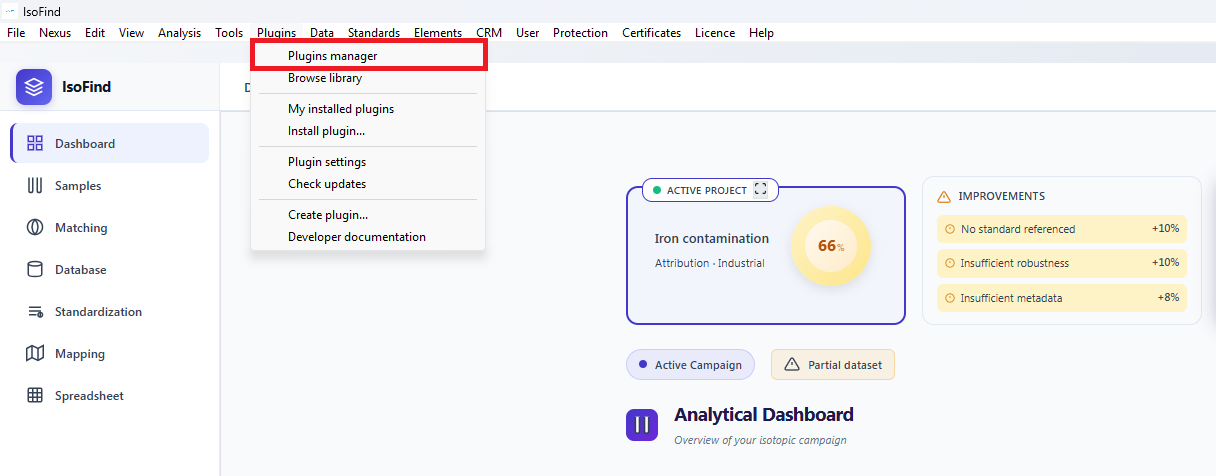 Figure 1: "Plugin manager" menu under the "Plugins" menu.
The manager centralises all plugins installed on your instance. It presents a dashboard with the total number of plugins, the number of active plugins and available updates.
When offline mode is enabled, an orange badge appears in the manager title. This mode blocks all network connections initiated by plugins.
Installing a Plugin
Plugin manager
›
Install a plugin
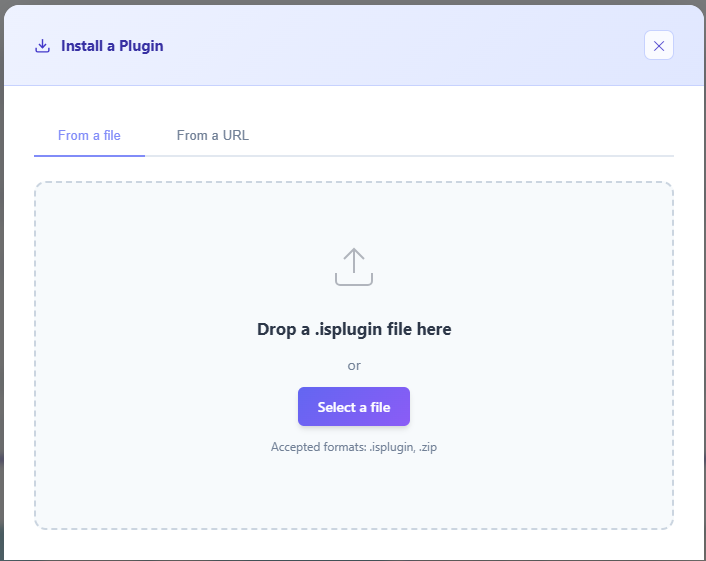 Figure 2: Plugin installation menu.
IsoFind offers two installation methods depending on your network configuration.
From a file
Drag an .isplugin or .zip file directly into the drop zone, or click Select a file to open the file browser. IsoFind reads the plugin manifest, verifies the required fields and installs the code automatically.
The installation proceeds through seven steps visible in the progress bar:
| Step | Operation |
|---|---|
| 1 | Environment preparation |
| 2 | File reading |
| 3 | Archive decompression |
| 4 | Manifest reading and validation |
| 5 | Main code extraction |
| 6 | Conflict detection |
| 7 | Finalisation and registration |
From a URL
Enter the direct URL of an .isplugin file in the provided field and click Download. IsoFind downloads and installs the plugin in a single operation. This method is not available when offline mode is active.
If JSZip is not loaded in your instance, installation from a .zip file will fail with an explicit message. Verify that the library is included in your configuration.
Plugin Structure
Each plugin is an archive containing at minimum two files: a manifest and a main code file. The manifest describes the plugin and its requirements; the code file contains the logic executed by IsoFind.
The manifest file
The manifest is a manifest.json file placed at the root of the archive, in the v2 format (schema plugin-manifest-v2). Five fields are required. Unknown fields are rejected: the manifest accepts only the keys below.
| Field | Type | Required | Description |
|---|---|---|---|
| id | string | Required | Unique lowercase identifier (3 to 64 characters, pattern a-z 0-9 . _ -). Used as the install key. |
| name | string | Required | Name displayed in the manager. |
| version | string | Required | Semantic version X.Y.Z. Used for sorting and update detection. |
| sdk | object | Required | SDK compatibility, in the form { "min": "2.0.0" }. The host refuses a plugin whose min exceeds its own SDK version. |
| entry | string | Required | Main code file inside the archive. Defaults to plugin.js. Replaces the former main field. |
| description | string | Short description (600 characters maximum). | |
| category | string | analysis, visualization, data or tools. | |
| icon | string | URL of an icon, optional. | |
| author | object | Object { name, email, url }. Note: this is no longer a plain string. | |
| license | string | Plugin licence. | |
| repository | string | Source repository URL, shown as a "Source code" link. | |
| homepage | string | Plugin presentation page. | |
| keywords | array | Keywords (16 maximum). | |
| compatibility | object | Target editions: { "scope": "core" } (compatible with all editions) or { "scope": "editions", "editions": [...] } (limited to the listed editions). | |
| dependencies | array | Identifiers of other required plugins (see Dependencies Between Plugins). | |
| capabilities | array | Requested capabilities (see Capabilities). Without any capability, a plugin can only compute. | |
| contributes | object | Declared extension points: formulas, menus, panels (see Extension Points). | |
| signature | object | Detached signature, verified before execution (see Signature and Certificate). |
The move from the permissions field to capabilities, and from main to entry, reflects the v2 model running in a sandbox. The historical language field no longer exists in the v2 manifest.
Extension Points (contributes)
The contributes field declares in advance what the plugin adds. The host therefore knows its extension points without executing the code, which also feeds the no-code creation wizard.
| Extension point | Shape | Effect |
|---|---|---|
| formulas | list of { name, group, label, syntax, example } | Adds spreadsheet functions. The name is uppercase, as invoked in a cell; the formulas appear in the spreadsheet function selector. |
| menus | list of { id, label } | Adds menu entries. Requires the ui:menu capability. |
| panels | list of { id, label } | Declares panels that can be opened in the interface. Requires the ui:panel capability. |
Capabilities
A plugin declares the capabilities it needs in its manifest. Each call to the host is refused if the corresponding capability was not granted at installation. A manifest without any capability can do nothing but compute. Nine capabilities exist. There is no file-system capability: the sandbox does not expose the disk to plugins.
| Capability | Access granted |
|---|---|
| samples:read | Read the samples of the active database. |
| samples:write | Write samples. |
| analysis:run | Run internal analysis pipelines. |
| config:read | Read the plugin's own persistent configuration. |
| config:write | Write that configuration. |
| ui:notify | Display a notification in the interface. |
| ui:menu | Add a menu entry. |
| ui:panel | Open a panel in the interface. |
| network | Network requests. Blocked in offline mode, even when declared. |
IsoFind API for Plugins
Each plugin has access to a global API object that exposes IsoFind interaction functions. This object is injected automatically at plugin execution.
Available functions
| Function | Description |
|---|---|
| API.getSamples() | Returns the list of samples from the active database |
| API.getSelectedSamples() | Returns only the samples selected by the user |
| API.showNotification(message, type) | Displays a notification in the interface. Types: success, error, info, warning |
| API.registerMenuItem(label, callback) | Adds an entry to IsoFind's main menu |
| API.createPanel(html) | Creates a floating panel in the interface with the provided HTML content |
| API.getConfig(key) | Reads a persistent configuration value specific to the plugin |
| API.setConfig(key, value) | Writes a persistent configuration value specific to the plugin |
Sandbox and SDK
Each plugin runs inside an isolated iframe. It never touches the application directly: it talks to a host bridge through messages. The capabilities granted at installation are passed to that iframe, and each host function is gated by the corresponding capability. For example, reading samples requires samples:read, displaying a notification requires ui:notify, and opening a panel requires ui:panel.
The host SDK version is 2.0.0. The manifest's sdk.min field sets the minimum required version; the host refuses a plugin that requires a version newer than its own.
The functions listed above are reached through this bridge and remain subject to capabilities: a call not covered by a granted capability is simply ignored. Menu entries, panels and formulas are not created through free calls but declared in contributes.
Signature and Certificate
A plugin can be signed to prove its origin. The signature is detached and verified by the host before any execution. It reuses the IsoFind PKI, with the same conventions as ISOF file signing.
| signature field | Description |
|---|---|
| algorithm | ECDSA-P256 (P-256 curve, SHA-256 digest). |
| certificate_chain | Chain from author to Issuing CA, each certificate as base64 of PEM (at least two). The Root is pinned on the verifier side. |
| signature_b64 | ECDSA signature in base64. |
| code_sha256 | Informative. The verifier always recomputes this digest from the actual code. |
What is signed is the canonical JSON of the pair "manifest without the signature field" and "digest of the entry-point code". Manifest and code are thus bound by a single signature: changing one invalidates the other. The chain goes up from the author to the Issuing CA and then the IsoFind Root, the latter being pinned by the verifier.
An unsigned plugin remains installable, but the host flags it as unverified. The Verify signatures setting (global settings) enforces verification before installation. The author's certificate is the one issued at enrolment (CSR generation, then signing in the IsoFind manager).
Dependencies Between Plugins
A plugin can declare in dependencies the identifiers of other plugins it needs. At installation, missing dependencies are offered for download and installed in chain, in the correct order. The system detects dependency cycles to avoid looping installations.
Python Plugins
Manifest
›
language: "python"
IsoFind supports plugins written in Python via Pyodide, a full Python environment running in the browser. The numpy and pandas packages are loaded automatically. The scipy and matplotlib packages can be requested on demand.
Python code accesses IsoFind data via the isofind module injected automatically into the Pyodide environment:
| Python method | JavaScript equivalent |
|---|---|
| IsoFindAPI.get_samples() | API.getSamples() |
| IsoFindAPI.get_samples_df() | Returns a directly usable pandas DataFrame |
| IsoFindAPI.notify(message, type) | API.showNotification() |
Loading Pyodide from the CDN is blocked in offline mode. To use Python plugins without an internet connection, configure a local path to Pyodide in the plugin settings.
Conflict Detection
Before any installation, IsoFind automatically analyses the plugin code to detect potential conflicts with already-installed plugins and dangerous code patterns.
Checked conflicts
| Conflict type | Risk level | Description |
|---|---|---|
| Global variables | High | The plugin declares a variable already used by an installed plugin |
| Menu names | Medium | A menu entry shares the same name as an existing menu |
| Shared permissions | Low | Two plugins may modify the same data simultaneously |
| Similar category | Low | One or more plugins of the same category are already installed |
| localStorage.clear() | Critical | Deletion of all session data |
| document.write() | High | Can entirely erase the page content |
| eval() | High | Dynamic code evaluation, security risk |
| innerHTML injection | Medium | Injection of script tags into the DOM |
If a conflict is detected, a summary window lists the issues before presenting two options: cancel the installation or install anyway. Critical-level conflicts cannot be bypassed.
Enabling and Disabling a Plugin
Each plugin card in the manager has an activation toggle. Disabling a plugin unloads its code from memory without uninstalling it. The plugin retains its settings and can be re-enabled at any time.
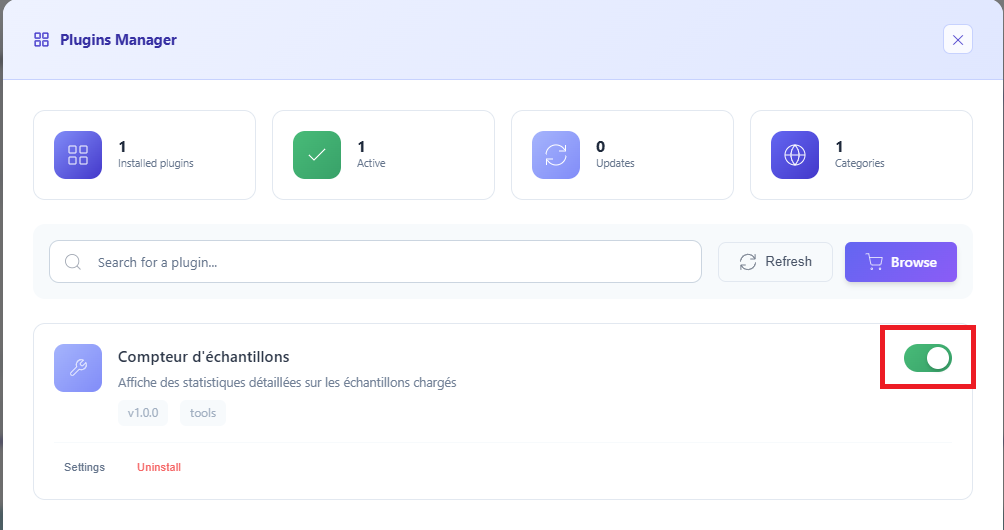 Figure 3: Enabling or disabling a plugin.
An enabled plugin is loaded automatically each time IsoFind starts. Its code runs in the global application context and can interact with the interface from launch.
Plugin Settings
Manager
›
Plugin card
›
Settings
The plugin settings window displays its complete information: version, author, description, identifier, category, installation date and contact address. If the plugin declares a repository in its manifest, a direct link is displayed.
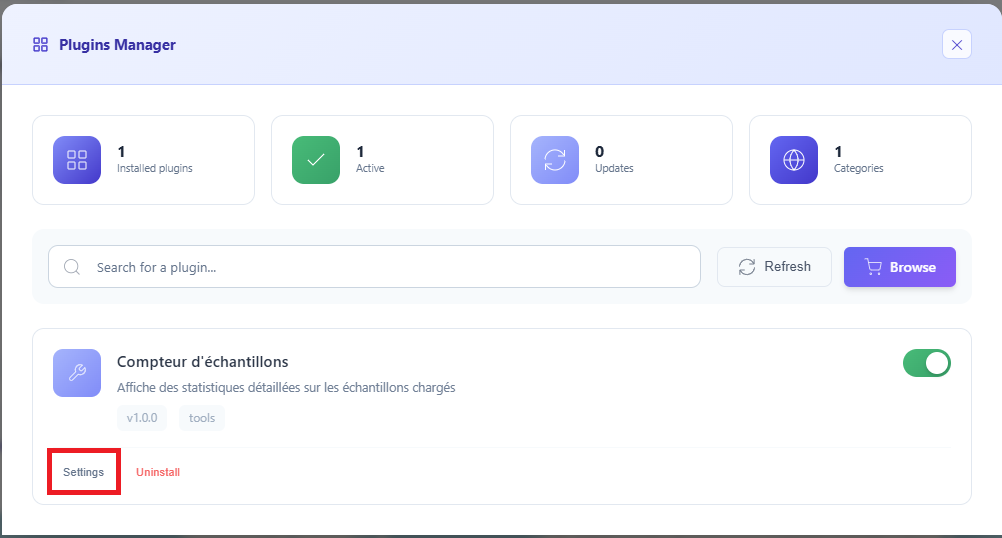 Figure 4: Accessing plugin settings.
A Check for update button compares the installed version against the version available in the online library. If an update is detected, confirmation is requested before installation. This check is disabled in offline mode.
Uninstalling a Plugin
Uninstalling permanently removes the plugin and its configuration data. The operation is irreversible. IsoFind requests confirmation before proceeding.
If the plugin was active at the time of uninstallation, its code is unloaded from memory before deletion. Menu entries registered by the plugin are removed immediately.
Global Plugin Settings
Plugins
›
Plugin settings
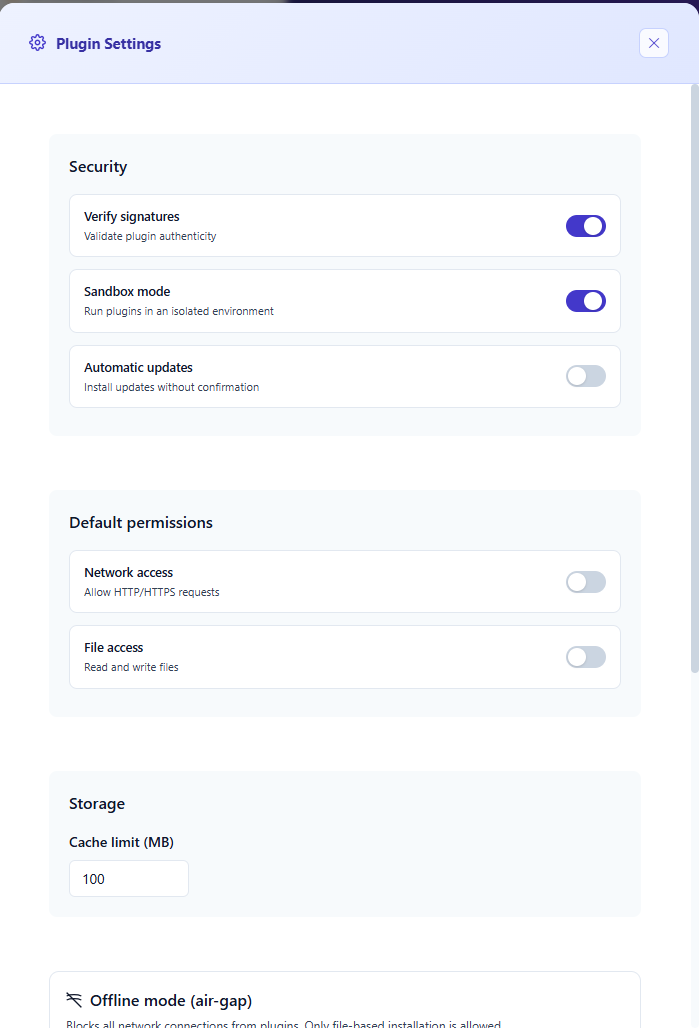 Figure 5: Global plugin settings.
Security
| Setting | Description | Default value |
|---|---|---|
| Verify signatures | Validates plugin authenticity before installation | Enabled |
| Sandbox mode | Runs plugins in an isolated environment | Enabled |
| Automatic updates | Installs updates without requesting confirmation | Disabled |
Default capabilities
These settings define the capabilities granted by default to newly installed plugins. They do not modify the capabilities of plugins already in place.
| Capability | Default value |
|---|---|
| Network access (network) | Disabled |
Offline Mode (Air-Gap)
Plugin settings
›
Offline mode
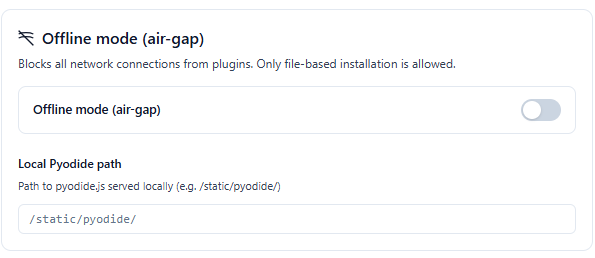 Figure 6: Air-gap mode settings.
Offline mode is designed for environments without internet access, particularly sensitive infrastructures or isolated network workstations. When active, all network connections initiated by plugins are blocked at the system level.
The following features are disabled in offline mode:
| Feature | Behaviour in offline mode |
|---|---|
| Installation from a URL | Tab hidden in the installer |
| Online library | Access blocked with notification |
| Update checks | Blocked with notification |
| Pyodide loading (CDN) | Blocked unless a local path is configured |
| Plugin network capability | Blocked even if declared in the manifest |
Local path for Pyodide
To use Python plugins in offline mode, you must download Pyodide and serve it locally. Enter the path to pyodide.js in the Local Pyodide path field. Example: /static/pyodide/.
Pyodide can be downloaded at github.com/pyodide/pyodide/releases. Place all files in a directory served by your IsoFind instance and enter the full path in the settings.
Exporting and Importing Plugins
The Export plugins section in settings allows you to save all installed plugins to an .isoplugins file. This file contains the metadata of all plugins and can be imported on another IsoFind instance.
To import a bundle, click Import an archive and select an .isoplugins file. IsoFind adds plugins absent from the instance without overwriting those already present.
The .isoplugins format contains only plugin metadata, not their source code. For a complete installation in an offline environment, also provide the corresponding .isplugin files.
Creating a Plugin
Plugins
›
Create a plugin
The creation wizard guides you through building a plugin in four steps. No prior knowledge of archive structure is required: IsoFind generates the manifest and prepares the exportable file.
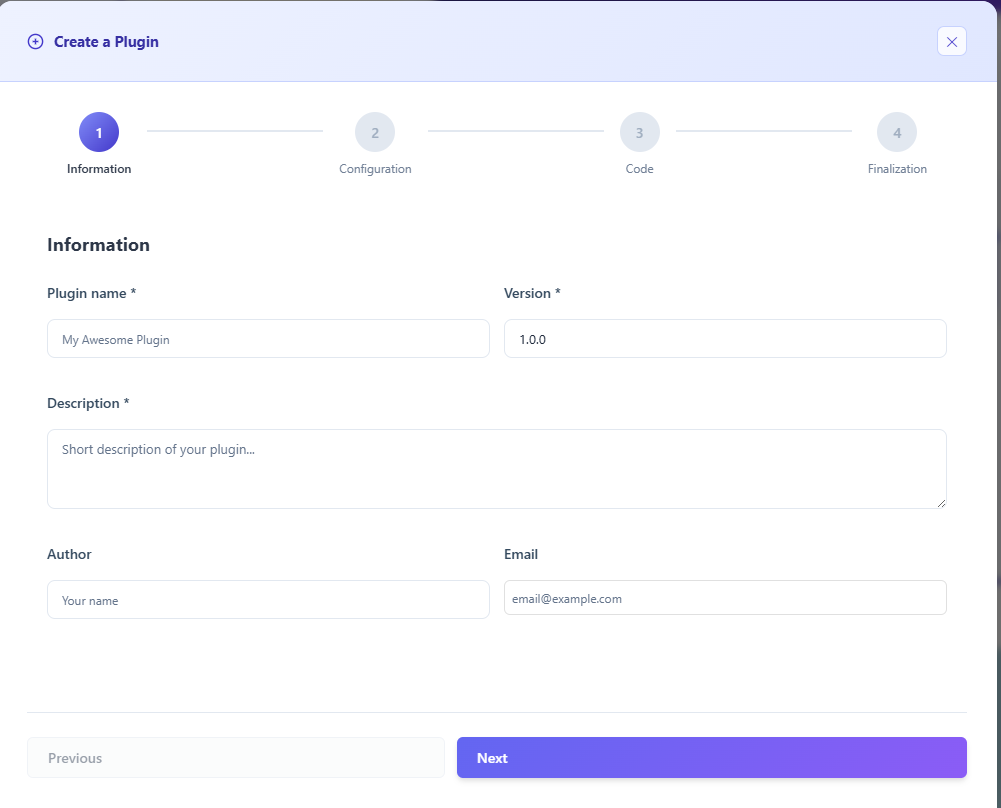 Figure 7: Plugin creation wizard.
| Step | Content |
|---|---|
| 1. Information | Name, version, description, author, email |
| 2. Configuration | Language (JavaScript or Python), required capabilities |
| 3. Code | Code editor with starter templates |
| 4. Finalisation | Summary, export options (README, icon), file generation |
Available templates
Four starter templates are offered at the Code step. Each contains a functional structure ready to modify.
| Template | Typical use |
|---|---|
| Empty | Start from scratch, minimal structure only |
| Basic | Simple plugin with notification and menu entry |
| Analyser | Isotopic data processing and result display |
| Visualiser | Creating a graphical panel in the interface |
Connecting to the Site: Registry and Relay
The online library and the website both rely on the same catalogue, the registry.json registry (schema isofind-plugin-registry/v1) published on the site. Each entry describes a plugin and points to its signed .isplugin archive, without embedding the code.
| Entry field | Required | Description |
|---|---|---|
| id, name, version, category | Required | Plugin identity and category. |
| download_url | Required | URL of the signed .isplugin archive. |
| author, author_cn | Declared author and signing certificate subject, shown as-is when the plugin is signed. | |
| capabilities, sdk, compatibility | Requested capabilities (shown before download), minimum SDK version, compatible editions. | |
| dependencies, repository | Required dependencies and source repository. | |
| downloads, size, updated, icon | Display and sorting metadata. | |
| signed | Declarative indication from the registry. It does not replace the signature verification performed at installation. |
The application does not contact the site directly. It reads the registry through a local relay served by its own backend, at /plugins/registry.json, which fetches the catalogue server-side from the site. The frontend thus stays same-origin: no CORS issue, and no application token leaves toward a third party. The relay also rewrites the download_url values to /plugins/files/, so that archive downloads also stay same-origin.
In offline mode, this relay and the library are unreachable, like other network access. Distribution then happens through .isoplugins bundles and .isplugin archives provided manually.
Reference Plugins Provided
Several reference plugins are provided, signed, ready to install and to serve as a template. They use only the interface capabilities, with no access to data or to the network.
| Plugin | Identifier | Category | Role |
|---|---|---|---|
| Extensions Hub | plugin-hub | tools | Entry point for extensions, loaded automatically. |
| 14C Dating | c14-dating | analysis | Radiocarbon dating panel. |
| U-Th Dating | uth-dating | analysis | Uranium-thorium dating, closed-system age equation from activity ratios. |
| Advanced Spreadsheet Formulas | tableur-advanced-formulas | tools | Statistics, isotopy, mixing and Rayleigh, error propagation, York regression, rare-earth anomalies. |
Plugin Library
Plugins
›
Browse the library
The library lists published plugins compatible with your version of IsoFind. It allows filtering by category and sorting by popularity, publication date or rating. Installation is one click from each plugin's details page.
The library is not accessible in offline mode. To distribute plugins in this context, use the .isoplugins bundle export and import.
To submit a plugin to the official library, see the Contribute page on the IsoFind website. Third-party plugins are subject to a code review before publication.