
3
Li
7Li/6Li
IsoFind brings together, in one environment, published isotope values, your own measurements, geochemistry and the tools you already use: R, Python and PHREEQC. Values stay comparable from one laboratory to the next, calculations can be rerun, and results remain readable without IsoFind.
Isotope geochemistry · Analytical chemistry · Ore deposit geology · Mining environments
The Atlas and the standards conversion are free to use. Essential is free forever, and IsoFind Pro funds development. Windows, Linux version coming soon.
These twelve systems are the ones whose isotopic fractionation is modelled natively. Any other isotope can be supported in IsoFind, and on the geochemistry side, every element and every molecule already is.
The Atlas brings together values taken from the literature: ore deposits, contaminated sites, fractionation experiments. Free to browse, no account needed.
Loading the database…
Hover over a point to preview it, click to keep the record open.Tap a point to show its record.
Two laboratories measuring the same material against different standards, or against two lots of the same standard, do not get the same value. The tool converts from published offsets, lot by lot, propagates the uncertainties and cites the source of every offset. When no offset has been published, it gives no value. Free, no account needed.
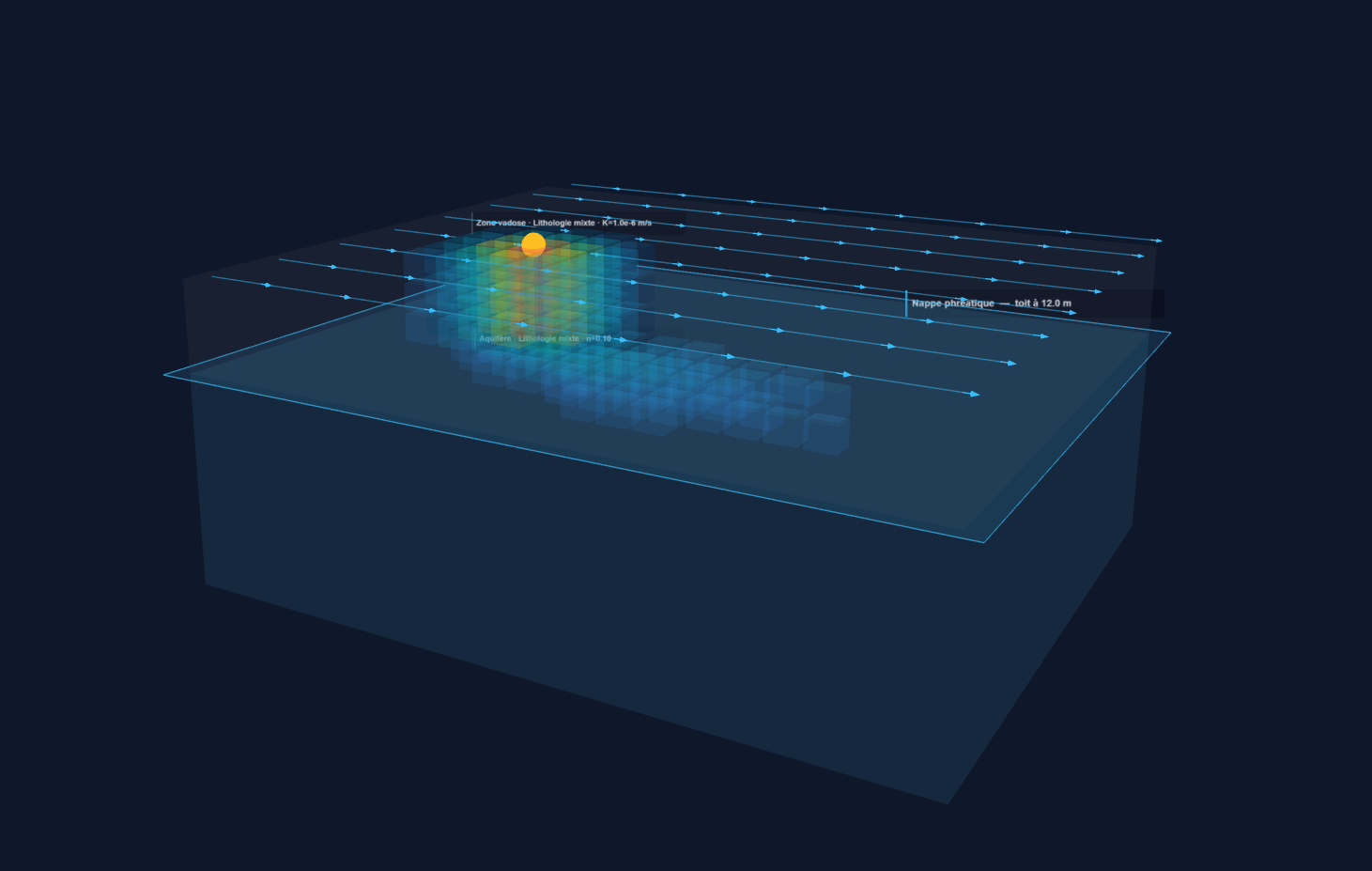
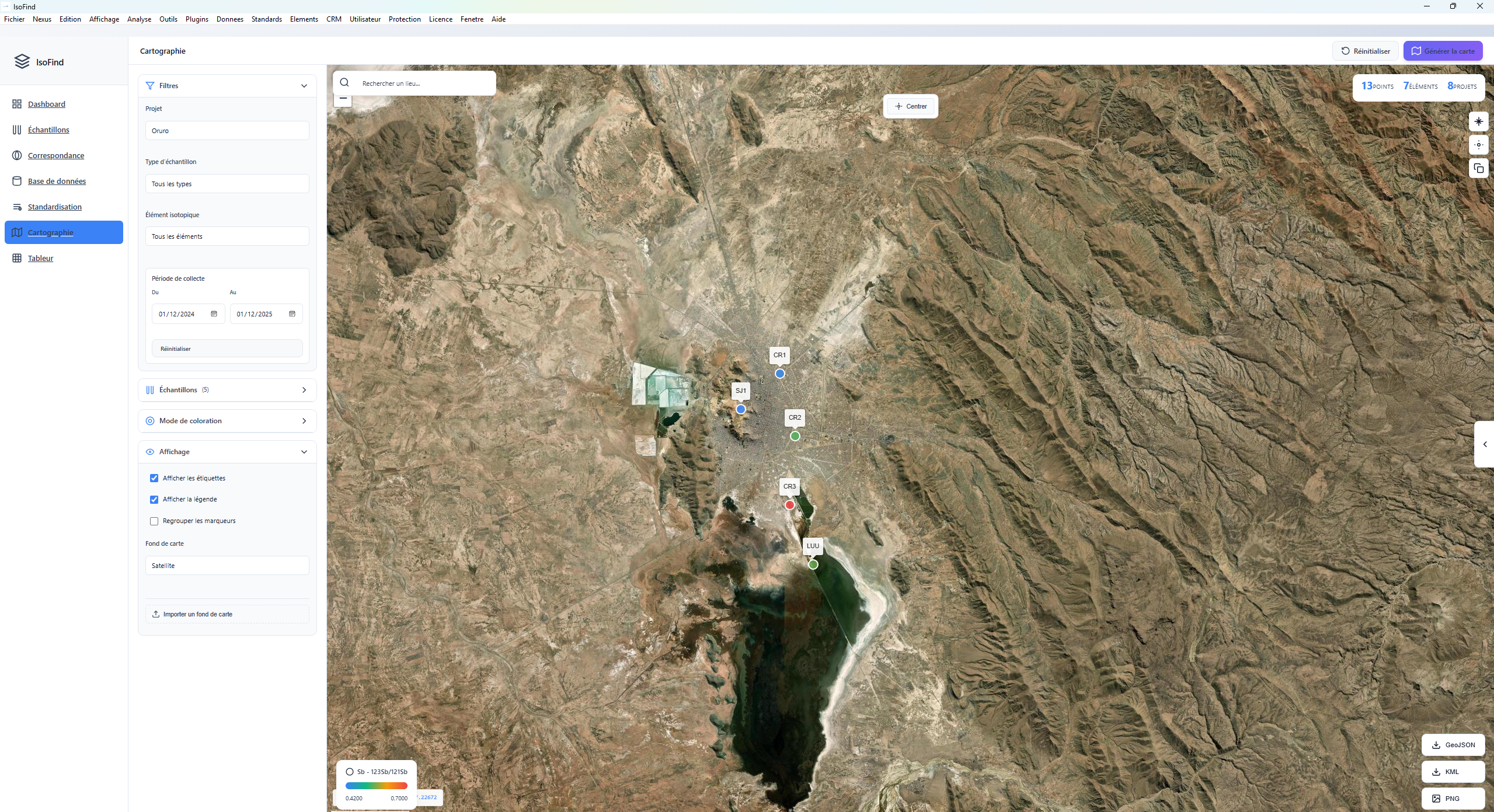
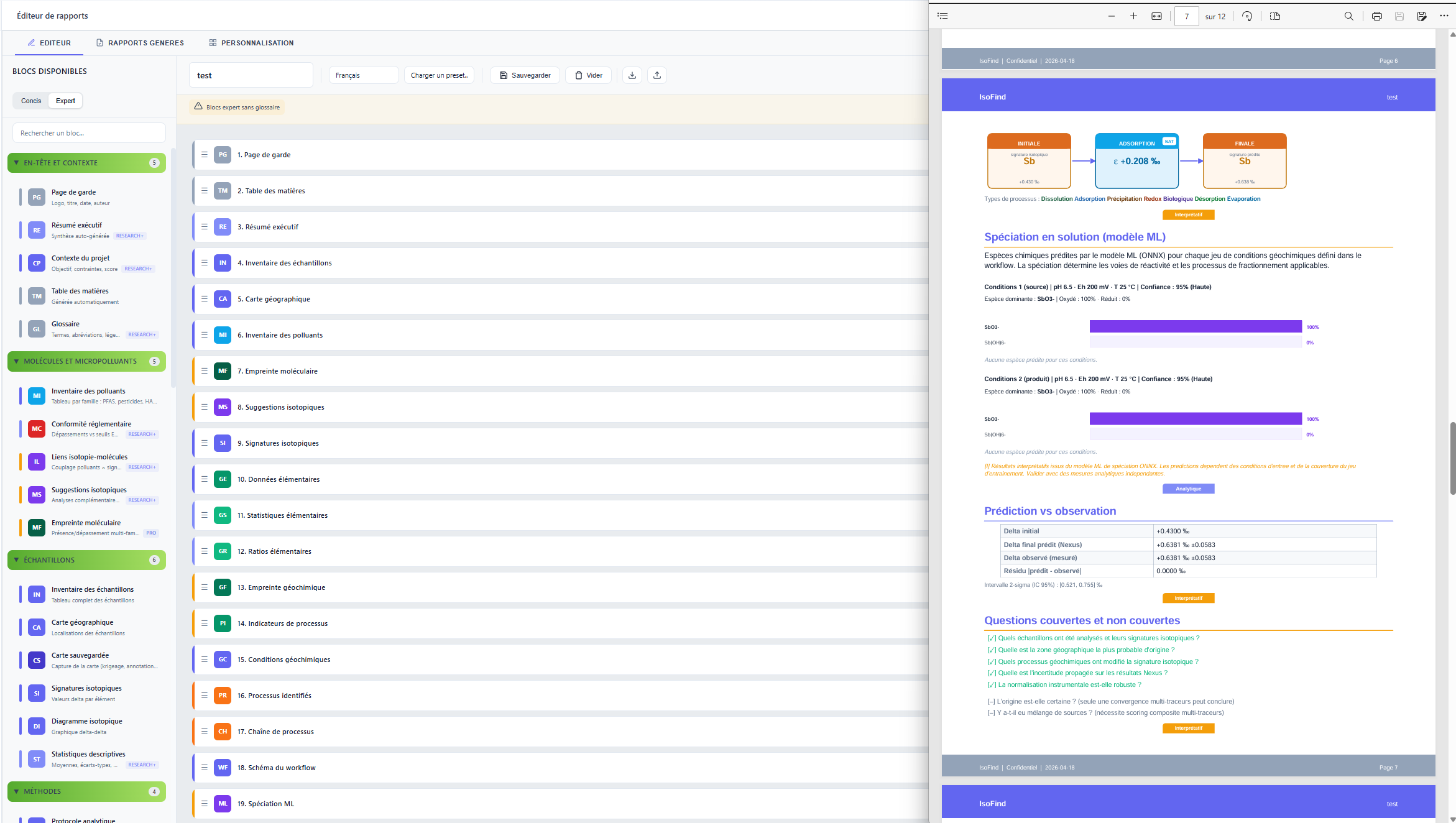
Volumetric reconstruction of a plume by interpolation, with cutting plane and time slider.
Carry on running your Python and R scripts directly on your data, without rewriting them or switching tools.
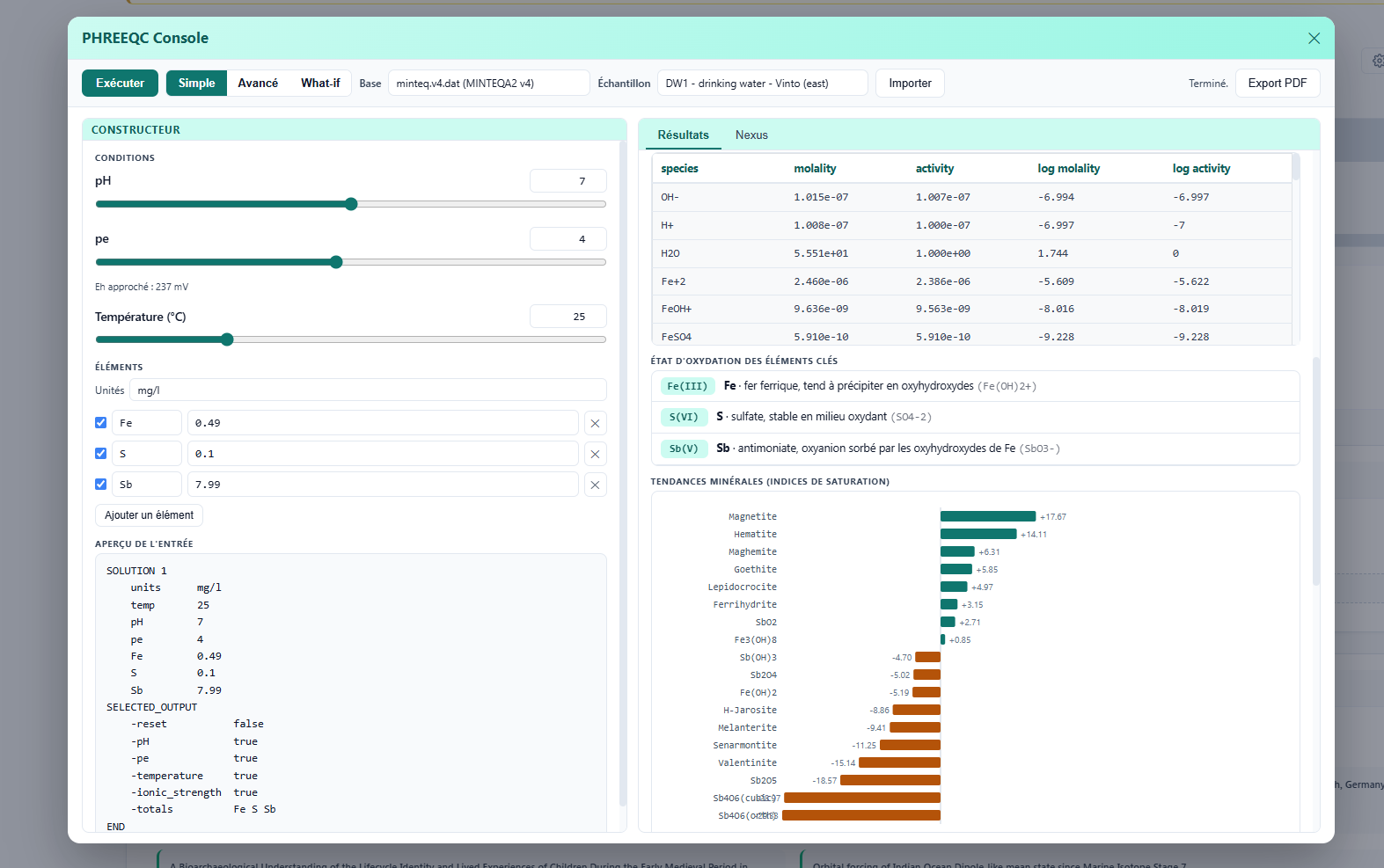
Speciation, reactive transport and isotope signatures in the same environment, instead of making two programs talk to each other.
Every result leaves as an open, signed file that carries its method with it, verifiable by a third party, even ten years from now.
A platform is only worth something if you can leave it. The plugin system is not a promise: R and PHREEQC are already two of them, free and available. Every brick exists so that your data and your methods stay yours.
Your results live in an open, signed file, readable without IsoFind. MIT licence.
Extend the platform to your needs. Two free plugins already ship, others come from the community.
Built-in console: your statistical scripts run straight on your datasets.
Model speciation and geochemical equilibria without leaving your environment.
Work with your data from your notebooks, using the isof package published on PyPI.
Plug IsoFind into your processing pipelines, your LIMS and your internal tools.
Import your existing tables without reformatting them by hand.
Runs on a fully isolated machine, with no connection and no remote account.
No data leaves your machine, no telemetry is sent back, and if you walk away from IsoFind one day, your files stay readable without it. No tracker, no advertising, no hidden subscription.
IsoFind covers the whole path of a piece of data: published values to see where you stand, the browser or the software to work on your own measurements and models, open formats to pass results on. Each tool can also be used on its own.
Published data
IsoFind Atlasfree Values from the literature, on a map. Standards conversionfree Published offsets between reference materials. IGDB databasesCC BY 4.0 The fractionation factors of the Atlas, ready for IGL.Your work
IsoFind softwareEssential free Your measurements, offline: geochemistry, isotopes, models, reports. Workspacebrowser Your measurements against the Atlas, without sending them. IGL workshopbrowser Write a model and run it, with nothing to install. R, PHREEQC, Pythonfree plugins Your scripts and speciation codes, on the same data.Planned: once your results are published, add them to the Atlas, with the article's DOI and a citation of your data.
TITLE
    Chromium reduction in a closed system

META
    author "Colin Ferrari"
    language 0.5

STANDARD
    standard NIST-SRM-979 0.11339 ratio 53Cr/52Cr

ISOTOPES
    ratio 53Cr/52Cr standard NIST-SRM-979

SPECIES
    species Cr(VI)
    species Cr(III)

RESERVOIR Groundwater
    volume 1 L
    Cr(VI) 1 umol/kgw
    delta53Cr 0 permil

PROCESS Reduction
    type reduction
    reactant Cr(VI)
    product Cr(III)
    location Groundwater
    extent 0.6

FRACTIONATION Reduction
    isotope 53Cr/52Cr
    epsilon -3.5

MODEL Closed
    progress extent
    processes [ Reduction ]

OUTPUT
    variable Groundwater.Cr(VI).delta53Cr
    variable Groundwater.Cr(III).delta53Cr
Reservoirs, processes, fractionation and standard fit in a plain-text file that reads like a methods section. Any conforming engine reruns it and gives the same result.
$ igl check model.igl
no diagnostics

$ igl build model.igl
model.iglir.json

$ igl run model.iglir.json
model.results.json
The model is checked, compiled, then run. The results file keeps the model's provenance and records where every value used comes from. The igl command is not yet released for download; the workshop runs the same engine in the browser.
{
  "version": "1.3",
  "header": {
    "lab_id": "ISO-REF-042",
    "timestamp": "2026-03-12T14:30:00Z"
  },
  "data": {
    "element": "Pb",
    "206Pb_204Pb": 18.234,
    "207Pb_204Pb": 15.612,
    "uncertainty": 0.002,
    "purification_yield": 98.7
  },
  "signature": "304502210089..."
}
Ratios, uncertainties, purification yield and protocol stay with the value, under the laboratory's signature. Any later change shows up on verification.
# pip install isof
import isof

cert = isof.load("sample_data.isof")
print(cert.is_valid())   # True
A colleague, a reviewer or an auditor checks the file on their own computer, with no account and no connection. If IsoFind disappeared, your files would remain readable.
IsoFind is led by Colin Ferrari, a geochemist. The project draws on isotope geochemistry for fractionation mechanisms, on analytical chemistry to judge what a measurement can be compared with, and on ore deposit geology to place each value in its context.
Isotope fractionation mechanisms of antimony, from calculation to experiment, then to the field.
Giant Mine remediation program, Northwest Territories, Canada.
“Tracing arsenic and antimony in mining-impacted environments: New insights from antimony isotopes”. Six first-author papers in total.


IsoFind Atlas, isofind.tech/atlas, accessed [date], after [reference of the publication].
Free reuse for research and teaching, citing the Atlas and the original publication. Commercial use goes through the Atlas access at the standard rate, and feeding a competing database remains excluded. IsoFind Atlas data licence
IsoFind, Isotope standards conversion. Ferrari C. (ed.). https://www.isofind.tech/en/standards-conversion/, accessed [date].
Also cite the publications behind the offsets used, listed with every copied result.
Ferrari C. (2026). IGL: Isotope Geochemistry Language, specification version 0.5 (draft). CC BY 4.0 licence. https://igl-lang.org/spec/
A model cites the language version written in its META block, a result the engine version written in its results file, and each factor the paper its database entry cites.
Comparing your own measurements with Atlas values now happens in the browser, without sending them to the server. What comes next is about what makes two measurements comparable, and about versions of the Atlas you can cite.
Available
Published values free to browse, conversion between standards lot by lot, distributions compared by group.
Available
Your measurements placed against Atlas values, computed in your browser, never sent to the server.
Next step
Beyond the standard: analytical method, material analysed and type of uncertainty, for every measurement.
Planned
Versioned Atlas, collections you can cite in a paper, deposit of your published data.
The Atlas, the conversion tool, Essential and Research are free. IsoFind Pro licences fund development: €99 a year excluding VAT for research and teaching, €290 for commercial use.
Add-on modules extend Pro, such as IsoSupply for critical raw materials compliance. Atlas access, with its analysis tools, is ordered separately, from €49 a year excluding VAT. Net prices, VAT not applicable, article 293 B of the French tax code.
24 articles organized into 6 thematic pillars, from the concrete use case to the scientific foundations. Around 10 minutes of reading per article.
https://atlas.isofind.tech/mcp, as a connector in the assistant. It needs no key and no account and only reads; the assistant receives each value with its source publication. Reads are limited per network, and the values are there to answer a question, not to train a model. Connect an assistant
isof, IGL models run on any conforming engine, and the software depends on no server: nothing can switch it off remotely.
Your question isn't here? Write to us directly
Open the Atlas to browse published values, or download Essential to work on your own measurements. If you have spotted an error, have data to contribute or want to discuss a collaboration, write to us.